Backtesting infrastructure
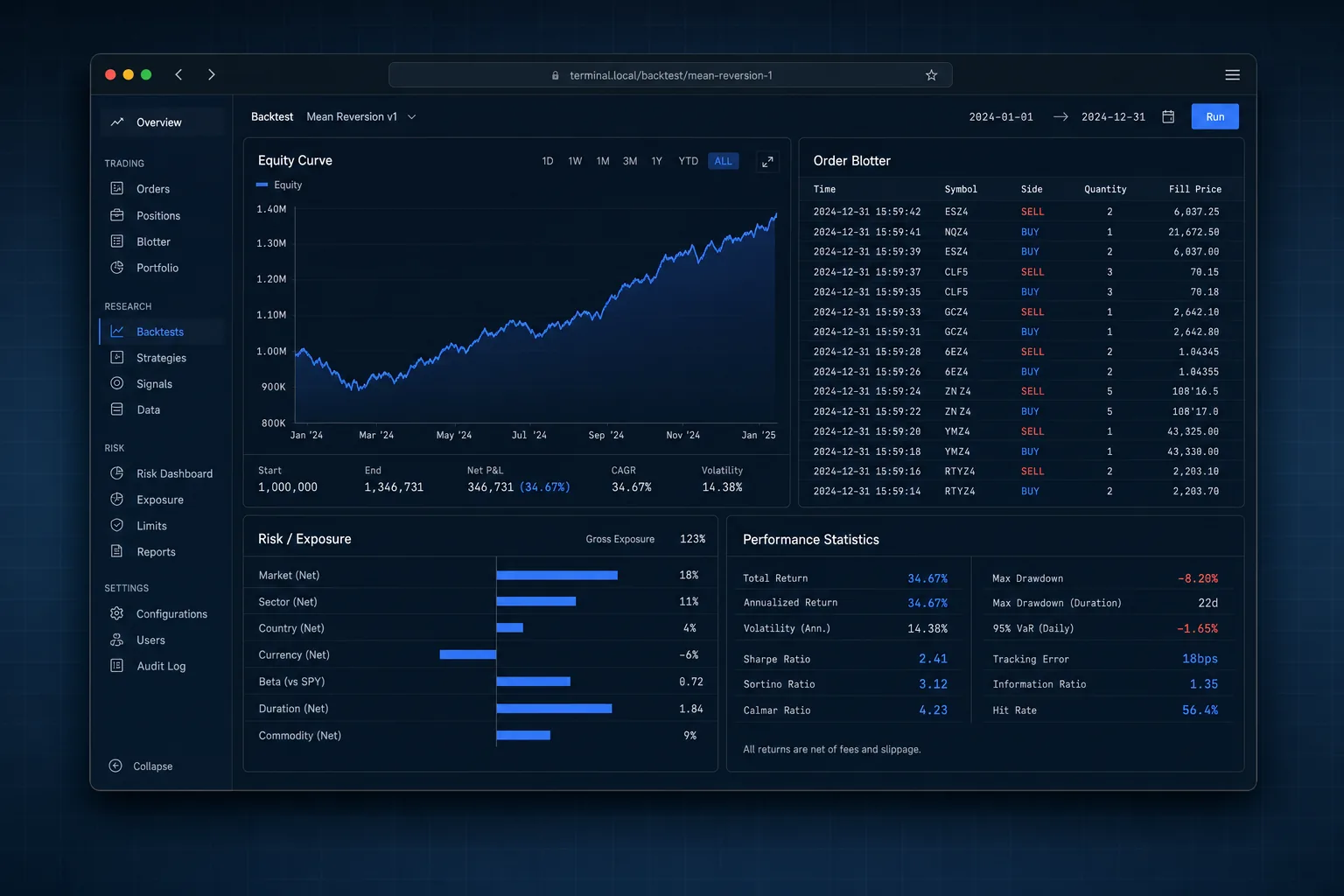
Historical simulation with realistic fees, slippage and no lookahead bias.

- Engagement
- Fixed-scope build
- Typical timeline
- 6–10 weeks
- Starts with
- Your price history plus one strategy you have already traded with real money.
The back-test drew a smooth line. Live trading produced something that looked nothing like it, and two months on nobody can say whether the strategy is wrong or the simulation was lying.
Results you can actually believe before deploying capital.
What we build
Concrete artefacts, handed over and documented.
An event-driven simulator that only ever sees data in the order it arrived, so tomorrow’s price cannot inform today’s trade
A cost model using your real fees, funding, borrow and spread per venue, instead of one flat assumption
Fill logic with market impact, which refuses to fill more than the order book could plausibly have absorbed
A point-in-time data layer holding corrections, delistings and restatements alongside the date each became known
A run archive: every result stored with its parameters and its code version, so a number found in a slide can be located months later
What changes
Simulated results land within a defensible distance of live results
Weak strategies die in the simulator rather than in the market
Research throughput rises, because a new idea becomes a configuration rather than a new script
How it runs
- Weeks 1–2
01Data audit
We examine your history for survivorship bias, look-ahead and gaps, and report what it can honestly support.
- Weeks 3–7
02Simulator
The event loop, the cost model and the fill logic, built so research and production share one definition of a trade.
- Weeks 8–10
03Calibration
We replay a strategy you have already traded live and tune costs and fills until simulation and reality agree.
Chosen per project. Named here so you can see the shape of it.
- Python
- pandas
- NumPy
- ClickHouse
- Dagster
Questions we get asked
Tell us the outcome, not the tooling.
Send us the situation you are in. We will tell you which discipline it belongs to, what we would do first and what it costs, including when the answer is to wait.