Financial algorithm development
Signal research, modelling and implementation with statistical validation at every step.

- Engagement
- Research engagement, milestone-based
- Typical timeline
- 8–12 weeks
- Starts with
- A written description of the edge you believe exists, however rough.
A rule that made money in a spreadsheet is not yet a strategy. The distance between an idea that looks profitable on old prices and one that survives fees, delays and a bad quarter is where most trading research quietly dies.
Strategies with evidence behind them instead of curve-fitted hope.
What we build
Concrete artefacts, handed over and documented.
- 01
A written hypothesis: what inefficiency the strategy exploits, in which instruments, and the conditions under which it should stop working
- 02
A signal and feature library in Python, versioned, with every input traceable back to the raw data it came from
- 03
Point-in-time datasets, so the research never sees a price, a correction or a filing before it actually existed
- 04
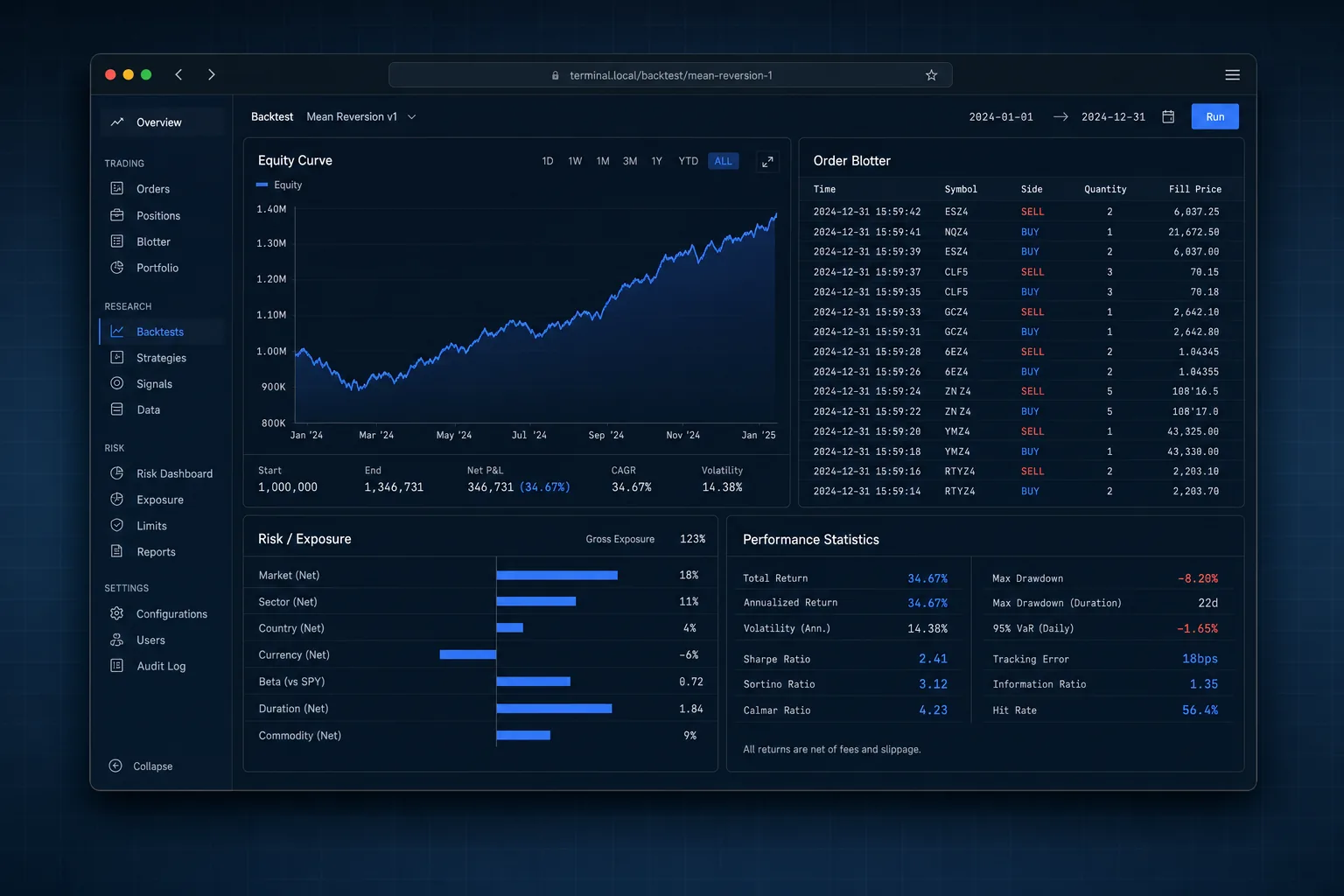
Walk-forward and out-of-sample testing, reported with the losing periods left in
- 05
A research note a risk committee can read: assumptions, capacity, expected decay, and what evidence would kill the idea
What changes
The idea is validated or discarded on evidence, usually inside one quarter
Any result can be reproduced from raw data by someone who did not write it
You know roughly how much capital the idea can carry before you size a position
How it runs
01Hypothesis and data
We write down what the edge is supposed to be, then assemble data honest enough to test it.
02Research loop
Feature construction, fitting, and deliberate attempts to break our own result before the market does.
03Verdict
Out-of-sample numbers, a capacity estimate and a written recommendation, including do not trade this, where that is the answer.
Chosen per project. Named here so you can see the shape of it.
- Python
- pandas
- NumPy
- QuantLib
- TimescaleDB
- Jupyter
Questions we get asked
Tell us the outcome, not the tooling.
Send us the situation you are in. We will tell you which discipline it belongs to, what we would do first and what it costs, including when the answer is to wait.